Information on different standards (as of 2012).
The importance of a standard on race falls to avoid deviations in time in relation to a pattern described and agreed to follow.
The following terms are offered to different standards Bulldogs Breed
- Standard FCI (group 2, Great Britain, Bulldog 149, for SPAIN) written on this page, then……………. http://www.fci.be/en/nomenclature/BULLDOG-149.html
- Standard The Kennel Club (UK)…. http://www.bulldogbreedcouncil.co.uk/
- Standard according Breed Council.. http://www.bulldogbreedcouncil.co.uk/standard.html
- Estándar BCA (Bulldog Club America) … http://www.bulldogclubofamerica.org/bulldog
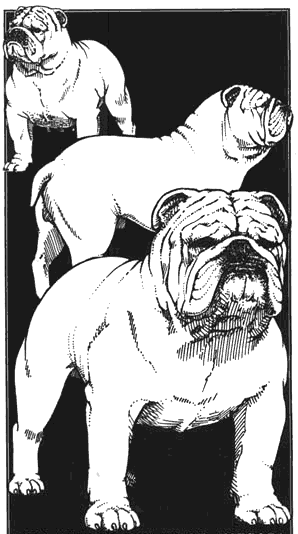
Please note that the images illustrated in the standards are not images to follow as a reference model and thus mentioned.
FCI-Standard No. 149 (in SPANISH) – BULLDOG – TRANSLATION: Birgitta Nestler / Original version: (EN) Technical Supervision: Miguel Angel Martinez.
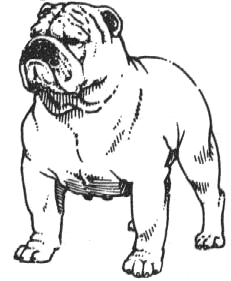
This illustration does not necessarily show the ideal example of the breed.
ORIGIN: Great Britain
DATE OF PUBLICATION OF THE OFFICIAL VALID STANDARD: 13.10.2010.
UTILIZATION: Companion Dog and deterrence.
CLASSIFICATION FCI: Group 2 – Pinscher and Schnauzer – Molossian and mountain type dogs, Swiss cattle.
Section 2.1 Molossoid, Dogue type. Without working trial.
BRIEF HISTORICAL SUMMARY: The Bulldog was first classified as such in 1630 by its previous mention of similar type referred to a bandog, a term used today for fighting dogs. originally used for the fight with bulls, the Bulldog fought their way and from 1835 began to develop in a version shorter and stockier face what we know today. He joined tracks exhibition in 1860 and the following years showed great personality change. A delightfully ugly dog with pugilist expression showing affection, affectionate nature towards family and friends. One of the oldest native breeds known as the National Dog of Great Britain and everyone associated with the legendary British determinations and John Bull.
GENERAL ASPECT : It is a short haired dog, something heavy, rather low in stature, broad, powerful and compact. Head rather large in proportion to their size, but no part of your body should be too large in relation to the other, thus breaking the general symmetry, by showing the deformed dog or interfering with its movement. Face relatively short, wide, blunt and inclined slightly upward but not excessive muzzle. Dogs showing respiratory problems are highly undesirable. something short body, good structure. strong, well muscled and robust members without tendency to obesity. tall and strong back. Females not as developed as dogs.
BEHAVIOUR / TEMPERAMENT: You should give the impression of determination, strength and activity. Alert, bold, loyal, dependable, courageous, fierce in appearance, but possessed of affectionate nature.
HEAD: Side view, head looks very high and moderately short from back to the tip of the nose. Front flat with skin on and around the head, slightly loose and finely wrinkled never prominent nor overhanging face excesses. The face from the cheek bones to nose, relatively short, with skin that may be slightly wrinkled. The distance from the inner corner of the eye (or the center-front naso between the eyes depression) at the end of the tip of the nose, should not be less than the distance from the tip of the nose to the edge of the lower lip.
CRANIAL REGION:
Skull : Skull relatively large in circumference. Seen from the front is high from the angle of the bottom to the top of the skull jaw, too wide and square. From stop, a furrow extends to the middle of the skull, being traceable to the apex.
Naso-frontal depression (Stop) : Defined.
FACIAL REGION: Front View, the three properties of the face must be equally balanced on either side of an imaginary center line.
Nose : Nose and large, broad and black nostrils, under no circumstances liver color, red or brown. Nostrils large wide and open, with well defined vertical straight line between.
Snout : Muzzle short, broad, turned upwards and deep from corner of eye to the corner of the lips. Wrinkle on the nose, if present, whole or broken, it should never adversely affect or hide the eyes or nose. Narrow nostrils and heavy over nose wrinkle is unacceptable and should be penalized severely.
Lips : Lips thick, broad, and deep, covering the sides of the lower jaw, but attaching the lower lip on the front. no visible teeth.
Jaws and teeth : Broad, strong, square jaw, lower jaw projecting slightly forward from the top with a moderate upward slope. Jaws broad and square with six small front between the canines in a row couple teeth. The canines wide apart, large, strong teeth that should not be seen when the mouth is closed. When front view of the lower jaw is just below the upper and parallel to it.
Cheeks : Cheeks well rounded and extended sideways beyond eyes.
Eyes : Seen from front, situated low down in skull, well away from ears. Eyes and naso-frontal depression are on the same straight line, at right angles to the front row. Well separated, however external angles within the outline of cheeks. Round, neither sunken nor prominent, very dark, almost black, moderate size showing no white when looking directly forward. Free from obvious eye problems.
Ears : High insertion, ie the leading edge of each ear (front view) touches the edge of skull at top corner, of, the highest so they are as far apart from each other and separated from the eyes as possible . Small and thin “rose-shaped ears” is correct, ie that internal wrinkles fall back, top edge, inner front, curving outwards and backwards, showing part of inside the ear canal.
NECK: Of moderate length, very thick, deep and strong. Well arched at the top, with some loose, thick and wrinkled skin around the throat form a slight dewlap on each side.
BODY :
Topline: Slight fall to back behind the tip of the shoulders (lowest part) whence spine should rise to loins (higher than the cross point), curving again more suddenly to tail, forming a slight arch a feature distinctive race.
Back: Short, strong, broad at the shoulder blades back.
Chest: Chest wide, prominent and deep. With well-defined body back ribs. Thorax rounded and deep. Well let down between the forelegs. Ribs not being flat on the sides, well rounded.
Underline and belly : Belly tucked up and not pendulous.
TAIL: Low insertion, jutting out rather straight and then turning downwards. Rounded, smooth and devoid of fringe or hard hair. Of moderate length, rather short than long, thick at the base, tapering quickly to a fine point. You must take it down (not having a decided upward curve at end) and never carried above the level of the top line. Absence of tail, inverted or very tight tails are undesirable.
MEMBERS FORWARDS:
General appearance: Forelegs short in proportion to the rear, but not so short as to make back appear long or as to hinder the activity of the dog.
Shoulders: Broad shoulders sloping and deep, very powerful and muscular giving appearance of being close to the body shoulder blades.
Elbows: Elbows red and well away from ribs.
Arm: Very beefy front and strong, well-developed legs, set wide apart, thick, muscular and straight, bones of legs large and straight, not bandy or curved.
Pasterns: Pasterns short, straight and strong.
Feet: Straight and turning very slightly outward, of medium size and moderately round. Toes compact and thick, well split up, making knuckles prominent and high.
MEMBERS HINDQUARTERS:
General appearance: Large and muscular legs, slightly longer than the front proportion. long legs and muscular from loins to hock.
Knees : Turns knees very slightly out of the body.
Hock: Hocks slightly bent, well let down.
Feet: Round and compact. Toes compact and thick, well split up, making knuckles prominent and high.
MOVEMENT: Walking with short, quick on the fingertips steps, the hind feet not lifted high, appearing to skim ground, running with one or other shoulder rather advanced. The strength of the movement is paramount.
SKIN:
Hair : Thin, short, close and smooth texture (hard only from shortness and closeness, not wiry).
COLOR : Or smut, (ie whole color with black mask or muzzle). Solid colors (which should be brilliant and pure of its kind) and brindle, red in its various shades, bays, griffon etc., white and pied (ie combination of white with any of the above colors) Color meat, black and black and tan highly undesirable.
SIZE AND WEIGHT
Male: 25 kgs.
Female: 23 kgs.
FAULTS: Any departure from the foregoing points should be considered a fault and the seriousness with which this should be taken should be in exact proportion to its degree and its effects on the health and welfare of the dog.
DISQUALIFYING FAULTS:
– Aggressive or overly shy.
– Any dog showing physical or behavioral abnormalities shall be disqualified.
NB : What males should have two apparently normal testicles fully descended into the scrotum. The latest changes are in bold.

STANDARD AND JUDGMENT ON
ENGLISH BULLDOG
OUR CRITICISM: Three nearly equal Standards but not equal, and so we understand.
Standard, standards, standars, Standard … does not matter as you type, pointed, “anglosajonado” … all the followers of a race in the form of culture know and understand their meaning, their importance to any race, and the Bulldog, not provides a single standard, no, different standards being considered and that confuses to unify criteria. On the one hand the FCI (The RSCE belongs to the FCI) on the other hand, the The Kennel Club (UK U.K.) and secondly the AKC (American Kennel Club)
What can cause this trio standards?
You believe that different standards Do They Clarify or confuse RACE? , Do you think that English judges, American and European abide wherever they go the standard of the country or area where you judge?
Honestly, we do not share the lack of unification
The standards are very or gaseous as our interpretive skills under a reading, want to catch them but can not, with so something relatively not very excessive, slightly, slightly, moderately, … create the “interpretative uncertainty.”
The Bulldog English without wrinkle is covered and there is no negativity in the absence of this facial wrinkle, however, consider the facial wrinkle as a “typical characteristics of the breed” and no standard mentions this typicality, although all exhibitors know that the facial wrinkle is necessary to offer quality in a RING.
We want one single breed standard worldwide, not similar but the same even in the format and writing most standard capacity to be followed comparison, formalized illustrations included support for all when interpreting what you want as an ideal bulldog,
You ARE INVITED to find the omissions and additions differences between estándares.¿por example, weight difference between male and female AKC, FCI, The Kennel Club? ¿Scoreboard in America, but in the UK there, or for the FCI?
Simply knowing each standard English Bulldog, we will conceive the Bulldog as a race but with different characteristics depending on location, and above all this, enjoy your Bulldog for being such distintivs race, either in the area or place that be.
Regards,
September 2012